@inproceedings{rahman2026winerf,
title = {WiNeRF: Measurement Constrained Radiance Fields for Actionable Wireless Channel Modeling},
author = {Rahman, Saif Ur and Murshed, Rafid Umayer and Dmitriev, Anton and Tanriover, Cagri and Shah, Rahul C. and Soltanaghai, Elahé},
booktitle = {Proceedings of the 2026 International Conference on Embedded Wireless Systems and Networks},
series = {EWSN '26},
publisher = {International Conference on Embedded Wireless Systems and Networks (EWSN)},
location = {Dresden, Germany},
pages = {25--37},
numpages = {13},
year = {2026},
month = sep,
doi = {10.3217/ck00-mq70},
url = {https://doi.org/10.3217/ck00-mq70},
keywords = {Wireless Channel Modeling, Channel State Information (CSI), Neural Fields, Neural Radiance Fields, Commodity WiFi, Beamforming, Angle-of-Arrival Estimation},
venue = {ACM EWSN '26},
topics = {Neural Fields, Channel Modeling, Commodity WiFi},
pdf = {https://ewsn.org/file-repository/ewsn2026/ewsn26-final38.pdf},
slides = {papers/talks/winerf-ewsn2026-slides.pdf},
image = {winerf.png}
}
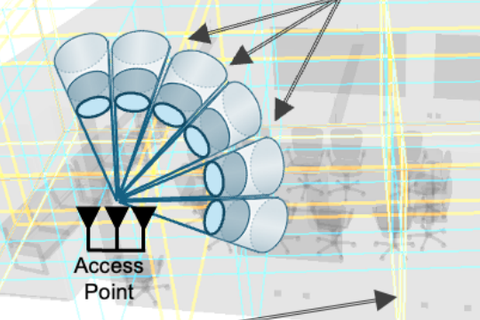
Wireless embedded systems increasingly rely on wireless channel information for decision making, yet practical platforms operate under severe constraints, including few antennas, narrow bandwidth, and sparse, noisy measurements. While neural field based approaches inspired by Neural Radiance Field (NeRF) have recently been explored for continuous wireless channel modeling, existing approaches depend on dense measurements or external priors such as known geometry, visual context, or angle-of-arrival (AoA) information, limiting their practicality in real-world deployments. We present WiNeRF, a neural field framework that learns a spatially continuous, complex-valued wireless channel representation directly from sparse channel state information (CSI) collected by commodity WiFi devices. WiNeRF embeds intrinsic system constraints, such as antenna geometry, limited spatial resolution, and phase uncertainty, as inductive biases through a 3D conical wave sampling model, a multi-resolution implicit scene representation, and a differentiable optimization framework for complex-valued channel learning. Across diverse indoor environments with non-line-of-sight (NLoS) regions, WiNeRF achieves a median prediction SNR of 5.3 dB, outperforming prior neural baselines by 4.9 dB on average (approximately 3x higher prediction SNR), and produces a task-agnostic channel representation that can be directly reused in standard signal-processing pipelines, including beamforming, AoA estimation, and RSSI coverage mapping, without modifying existing hardware or wireless protocols.
NeurIPS ’26
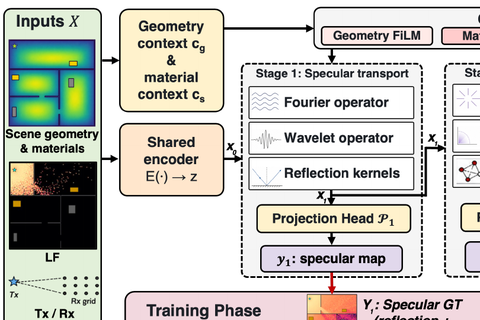
Physics-Unrolled Neural Operator for Wireless Field Modeling
Rafid Umayer Murshed, Saif Ur Rahman, Mingyue Tang, Elahé Soltanaghai
@inproceedings{murshed2026puhno,
title = {Physics-Unrolled Neural Operator for Wireless Field Modeling},
author = {Murshed, Rafid Umayer and Rahman, Saif Ur and Tang, Mingyue and Soltanaghai, Elahé},
booktitle = {Advances in Neural Information Processing Systems (NeurIPS)},
venue = {NeurIPS '26},
topics = {Neural Operators, Radio Maps, Wireless Simulation},
eprint = {2608.18495},
archiveprefix = {arXiv},
pdf = {https://arxiv.org/pdf/2608.18495},
image = {puhno.png},
year = {2026}
}
Talks
ACM EWSN ’26Dresden, Germany · Sep 17, 2026
WiNeRF: Measurement Constrained Radiance Fields for Actionable Wireless Channel Modeling