ESC

Research

WiNeRF — Learning Wireless Channels from Sparse WiFi Measurements
EWSN 2026 First author In collaboration with Intel

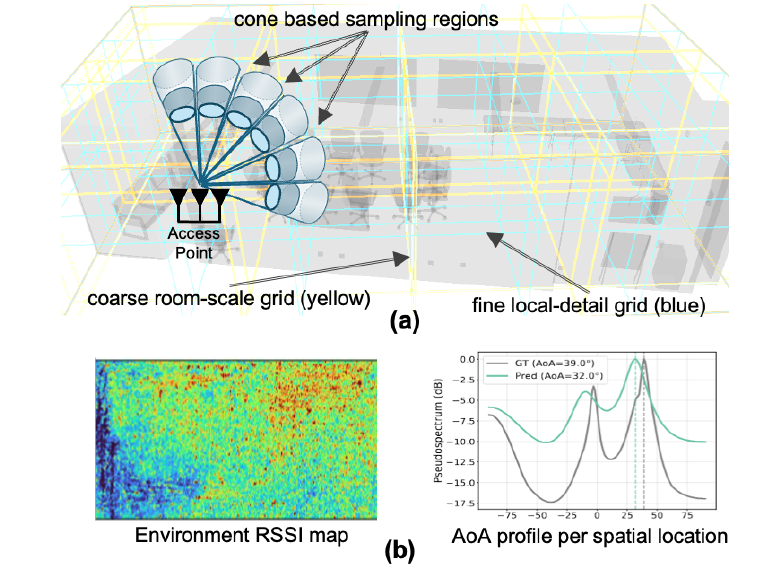
WiNeRF: cone-based sampling regions over a room-scale grid, plus an environment RSSI map and AoA profile

Can we build accurate wireless channel models without dense site surveys or detailed 3D maps? I developed WiNeRF, a physics-grounded neural field that learns a continuous, complex-valued wireless channel directly from sparse commodity WiFi CSI.

WiNeRF treats the antenna array's finite angular resolution and phase uncertainty as inductive constraints rather than assuming access to precise propagation geometry. The learned channel can be queried at previously unseen locations and used directly for downstream wireless tasks including beamforming, Angle-of-Arrival estimation, and coverage mapping.

Across approximately 30,000 synchronized CSI and pose measurements collected by a mobile robot in three indoor environments, WiNeRF achieved a 5.3 dB median prediction SNR and improved prediction SNR by approximately 3.0–6.7 dB over prior neural baselines.
CanopyTwin — Physics-Grounded Vegetation Modeling for Wireless Digital Twins

Ongoing research Neural operators Wireless digital twins

Vegetation remains difficult for scene-scale wireless simulation. Practical ray tracers often approximate foliage through penetration loss, effective material properties, or simplified scattering behavior, while explicitly resolving the many interactions among leaves, branches, and other structures can become prohibitively expensive at scene scale.

I am currently designing a physics-grounded neural-operator model that learns the aggregate scattering behavior of vegetation from high-fidelity physical simulation. The goal is to replace expensive leaf- and branch-level interaction modeling with a compact learned representation that can eventually be integrated into wireless digital twins for fast and differentiable propagation modeling.

This project is currently in the architecture and model-design stage. Current work focuses on identifying the right physical abstraction and learning formulation for complex multi-interaction scattering inside vegetation.

PU-HNO — Physics-Unrolled Neural Operators for Radio Maps

Submitted to NeurIPS 2026 Second author

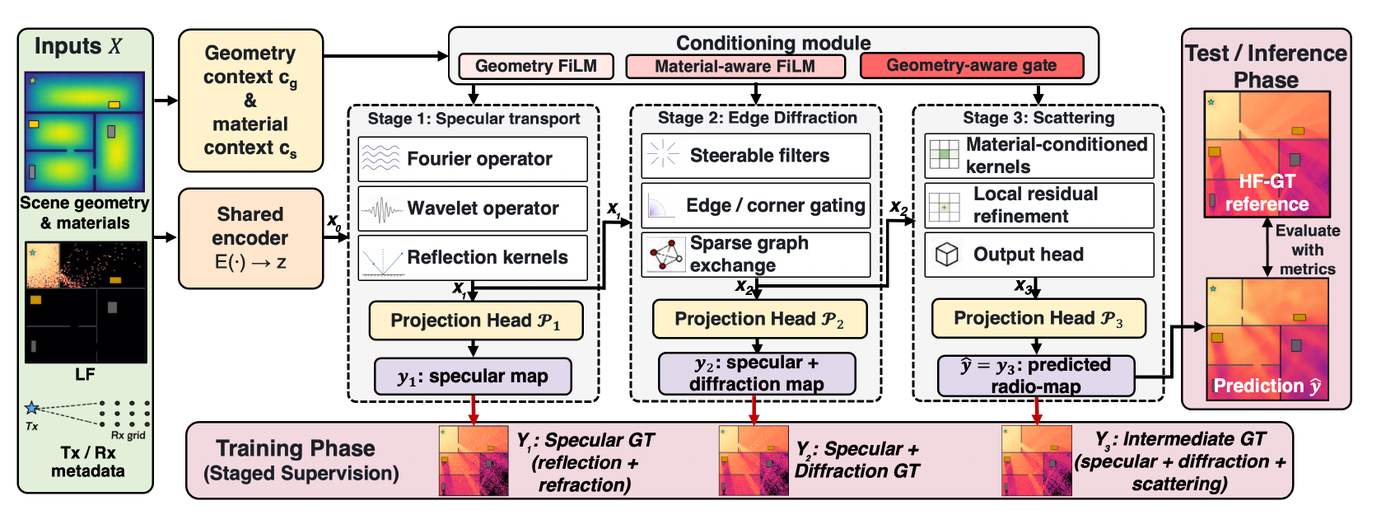
PU-HNO's three-stage neural-operator architecture: specular transport, edge diffraction, and scattering, with staged supervision

High-fidelity radio maps are expensive to simulate, while inexpensive finite-ray simulations are faster but contain noise and can miss fine propagation structure. PU-HNO uses a physics-unrolled neural-operator architecture that progressively refines wireless fields through stages associated with reflection, diffraction, and scattering rather than treating radio-map prediction as generic image-to-image regression.

I contributed to dataset generation and model development. The model achieved approximately 3.5 dB RMSE and 0.82 outage F1 against high-fidelity references. In one downstream access-point-placement experiment on a 10,000 m² floorplan, using the PU-HNO prediction resulted in approximately 92 Mbps throughput compared with 16 Mbps using a CNN prediction, despite relatively similar image-similarity scores.

WiViz — Making Invisible Wireless Mechanisms Understandable

Ongoing HCI + Wireless

Wireless interfaces usually show outcomes—signal bars, throughput, or coverage maps—but hide the physical mechanisms that produced them. WiViz explores whether interactive, mechanism-revealing visualizations can help non-experts reason about wireless behavior.

WiViz uses an interactive 3D environment built with Unity and Sionna RT to expose mechanisms such as propagation, blockage, reflection, multipath, and interference. In an initial 24-participant study, users of the mechanism-revealing visualization correctly identified underlying wireless mechanisms 80.6% of the time versus 24.2% with an outcome-only representation.

I currently lead the design of the next WiViz user study, which focuses on wireless literacy, mechanistic reasoning, and transfer to unfamiliar scenarios, and I occasionally contribute to implementation.

Earlier Research

WiSM — Non-Intrusive Soil Moisture Sensing Using WiFi Signals

Developed a contactless RF sensing system for estimating surface soil moisture from reflected WiFi-band OFDM signals using USRP software-defined radios. The system related received signal strength to dielectric properties through Topp's Equation and was evaluated indoors and in the field over approximately 0–30% soil moisture.

Breathing-Rate Estimation with Passive UHF RFID

Investigated respiration monitoring under free body movement using passive UHF RFID phase measurements. The project combined multi-tag motion information, signal processing, and an LSTM-based approach to study how breathing information could be separated from motion-induced corruption.

Urban Social Media Analysis

Built machine-learning and data-analysis components for a World Bank-funded urban-policy project at LUMS. The work included a BERT-based topic and sentiment analysis pipeline over approximately 500,000 tweets and an interactive dashboard for stakeholders.

Selected Software Projects

Raft Key-Value Store

Implemented a fault-tolerant replicated key-value store in Go using the Raft consensus protocol.

Blockchain Collectibles Marketplace

Developed a blockchain-based collectibles marketplace.